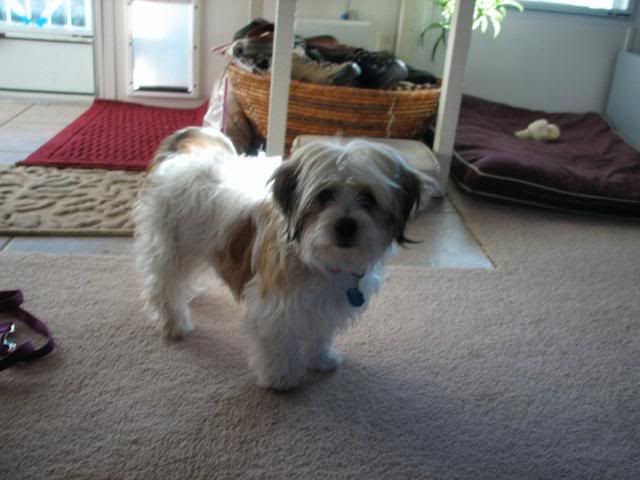
Hey, I'm just asking .... could you say "no" to this face?

.


Beef Wellington - A national hero for defeating Napoleon at Waterloo in 1815, Arthur Wellesley was made the first Duke of Wellington. He loved a dish of beef, mushrooms, truffles, Madeira wine, and pate cooked in pastry, which has been named in his honor.
Peach Melba - Chef Auguste Escoffier created a dessert of poached peach halves, vanilla ice cream, and raspberry sauce in honor of Australian opera singer Dame Nellie Melba. A Frenchman, Escoffier worked at the Ritz Hotel in London in the early 1900s, the period when Melba performed regularly at the Covent Garden opera house. Escoffier also created Melba toast in her honor.
Waldorf Salad - In 1896, Oscar Tschirky, the maitre d'hotel of the famed Waldorf-Astoria Hotel in New York City, created a salad of apples, celery, and mayonnaise. Immediately popular, the new dish was called Waldorf Salad. Chopped walnuts later became an ingredient.
Chicken Marengo - On June 14, 1800, Napoleon Bonaparte defeated the Austro-Hungarian army at the village of Marengo, in northern Italy. After a ferocious battle, the victorious French were ravenous. Chicken Marengo was made from whatever ingredients they were able to take from the village.
Caesar Salad - In the 1920s, Caesar Cardini, owner of an Italian restaurant in Tijuana, Mexico, and his brother, Alex, invented a salad of romaine lettuce, anchovies, coddled egg, lemon juice, grated Parmesan cheese, and garlic-flavored croutons tossed with a garlic vinaigrette flavored with Worcestershire sauce. At first it was called Aviator's Salad, but later Cardini named the dish after himself.
Beef Stroganoff - A combination of beef, mushrooms, and sour cream, Beef Stroganoff was the prize-winning recipe created for a cooking competition held in the 1890s in St. Petersburg, Russia. The chef who devised the recipe worked for the Russian diplomat Count Pavel Alexandrovich Stroganov, a member of one of Russia's grandest noble families.
The citrus soda 7-UP was created in 1929; '7' was selected because the original containers were 7 ounces. 'UP' indicated the direction of the bubbles.
The difference between apple juice and apple cider is that apple juice is the juice of the fruit only, and apple cider is the whole apple-skins, seeds, and all- which gives it the fuller body and deeper color. The juice is pasteurized and the cider is not.
The most expensive bottle of wine sold for $300,000. It was a bottle of 1787 Chateau Lafitte claret engraved with the initials of Thomas Jefferson.
COFFEE:
Germany is the world's second largest consumer of coffee in terms of volume at 16 pounds per person.
Over 53 countries grow coffee worldwide, but all of them lie along the equator between the tropic of Cancer and Capricorn.
An acre of coffee trees can produce up to 10,000 pounds of coffee cherries. That amounts to approximately 2,000 pounds of beans after hulling or milling.
The percolator was invented in 1827 by a French man. It would boil the coffee producing a bitter tasting brew. Today most people use the drip or filtered method to brew their coffee.
Up until the 1870s most coffee was roasted at home in a frying pan over a charcoal fire. It wasn't until recent times that batch roasting became popular.
Each year some seven million tons of green beans are produced world wide, most of which is hand picked.
Fast food restaurants use yellow, red, and orange because those are the colors that stimulate hunger.
Passion fruits have a tranquilizing effect on the body.
A one-third pound stalk of broccoli contains more vitamin C than 204 apples.
It takes about three hours for food to be broken down in the human stomach.
Chocolate contains the same chemical, phenylethylamine, that your brain produces when you fall in love.
Blueberries have more antioxidents than any other fruit or vegetables.
The McDonald’s at Toronto’s ‘SkyDome’ is the only McDonald’s location that sells hot dogs.
The average speed of Heinz ketchup leaving the bottle is 25 miles per year.




The first inaugural ball in Washington, DC, was held on March 4, 1809, on behalf of James Madison, the fourth president. It was held at Long's Hotel on Capitol Hill. Dancing started at 7 p.m. The U.S. Marine Band, which provided the music, has become a traditional feature at inaugurations.
The inaugural ball for James Buchanan was held in a building on Judiciary Square built for the occasion for $15,000. Six thousand guests drank $3,000 worth of wine and devoured 400 gallons of oysters, 60 saddles of mutton, four saddles of venison, 125 tongues, 75 hams, 500 quarts of chicken salad, 500 quarts of jellies, 1,200 quarts of ice cream, and a four-foot high cake.
An electric lamp hanging over the doorway to the 1881 inaugural ball of James A. Garfield, held at the Smithsonian Institution, was a novelty and intrigued the guests. John Philip Sousa conducted the U.S. Marine Band, which was one of two bands to entertain at the ball.
To accommodate all the guests, the number of balls has proliferated. Dwight Eisenhower had four balls, John Kennedy had five, Richard Nixon six, and Jimmy Carter, seven.
During Ronald Reagan's inauguration in 1981, 40 million jellybeans were eaten at the eight inaugural balls, which were televised by cable TV to inaugural parties around the nation. Reagan had begun nibbling his signature jellybeans in the 1960s when he quit smoking.
The weather was so cold during the second inauguration of Ulysses S. Grant that the valves on the band's musical instruments froze during the ball, and guests danced with their coats on.
Seeing the masses of people standing in that cold plaza in order to be part of this day, this event.
Hearing "America the Beautiful" sung so beautifully and meaningfully.
Recognizing that the stirring music of the string quartet, as beautiful as it was, was made even better by the symbolism of our national identity in the musicians, a blend of nationalities.
George H. W. and Barbara Bush wore purple scarves to signify that there should be no red or blue now, but the blending of American peoples working together.
The element of real life, human error during the oath, when the Chief Justice muffed the words a little, and Mr. Obama simply smiled and continued.
Several references, including of course, from President Obama, of coming together to put things right.
The President's speech was simple and direct, easy to understand, reflective of past while full of hope for the future.
The New President's reflection of the journeys of many to reach this place.
My interesting mixture of sense about our new President as being a very honest and real person that I could speak with directly and feel on an equal basis, and the immense sense of awe that I feel for him.
My own emotion as the national anthem was sung so beautifully while seeing our flag waving in the wind.
Thomas Jefferson was the only president to walk to and from his inaugural. He was also the first to be inaugurated at the Capitol. (1801)
The first inauguration to be photographed was James Buchanan's.
(1857)
William Taft's wife was the first one to accompany her husband in the procession from the Capitol to the White House. (1909)
Warren G. Harding was the first president to ride to and from his inaugural in an automobile. (1921)
Calvin Coolidge's oath was administered by Chief Justice (and ex-president) William Taft. It was also the first inaugural address broadcast on the radio. (1925)
Lyndon Johnson was the first (and so far) only president to be sworn in by a woman, U.S. District Judge Sarah T. Hughes. (1963)
Inauguration Day was originally set for March 4th in order to give members of the Electoral College from each State four months from election day to cast their ballots for president.
Weather's greatest impact on inauguration day came in 1841 when William Henry Harrison decided to brave the elements and deliver the longest inauguration speech ever, an oration lasting an hour, 40 minutes. Harrison wore no coat, and rode a horse to and from the Capitol ceremony. He subsequently caught a cold that developed into pneumonia. A month later, Harrison died.
The warmest January 20th inauguration day came in 1981 when Ronald Reagan was sworn into office under mostly cloudy skies. The temperature at noon on this inauguration day was 55 degrees.
The shortest inauguration speech was delivered by George Washington at his second inauguration on March 4, 1793. The speech totaled 135 words.
There have been nine presidents sworn in on days other than inauguration day — eight following presidential deaths and one after Richard Nixon's resignation.
Former President Herbert Hoover was unable to fly into Washington National Airport due to the weather and missed the swearing-in ceremony. By sunrise, the snowfall had ended and the skies cleared but the day remained bitterly cold. An army of men worked all night to clear Pennsylvania Avenue and despite the cold, a large crowd turned out for the swearing-in ceremony and inaugural parade.
Congressman John Conyers, Democrat from Michigan, first introduced legislation for a commemorative holiday four days after King was assassinated in 1968. The bill first came to a vote in the U.S. House of Representatives in 1979. However, it fell five votes short of the number needed for passage.
The King Center turned to support from the corporate community and the general public to make it a paid holiday. The success of this strategy was cemented when musician Stevie Wonder released the single "Happy Birthday" to popularize the campaign in 1980 and hosted the Rally for Peace Press Conference in 1981.
Six million signatures were collected for a petition to Congress to pass the law, termed by a 2006 article in The Nation as "the largest petition in favor of an issue in U.S. history.
At the White House Rose Garden on November 2, 1983, President Ronald Reagan signed a bill creating a federal holiday to honor King.It was observed for the first time on January 20, 1986. The bill established the Martin Luther King, Jr. Federal Holiday Commission to oversee observance of the holiday, and Coretta Scott King was made a member of this commission for life by United States President George H. W. Bush in May, 1989.
In 1990, Arizonans were given an opportunity to vote to observe an MLK holiday. McCain successfully appealed to former President Ronald Reagan to support the holiday. Prior to that date, New Hampshire and Arizona had not observed the day.
One place where this day is observed as important is in the Japanese city of Hiroshima under the mayor Tadatoshi Akiba, who holds special banquet at the mayor's office as an act of unifying his city's call for peace with King's message of human rights.


 weet. Then there is Murphy, a year old Chocolate Cocker Spaniel, who is adorable and H.Y.P.E.R!!! Sammy is hyper at times, but Murphy puts him to shame! I knew it would be hard for Sam, but a good lesson.

